The Viral Math Trap That’s Breaking the Internet
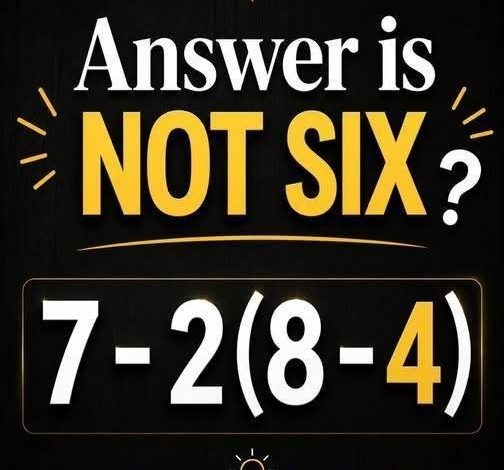
You have probably seen it while scrolling through your social media feed. It is a simple-looking math problem that pops up with a catchy, bold headline designed to grab your attention. Usually, it says something like “99% fail this!” or “Only geniuses get it right.”
ADVERTISEMENT
At first glance, the math problem looks like something you would see in a grade school classroom:
ADVERTISEMENT
8 ÷ 2(2 + 2) = ?
ADVERTISEMENT
It looks completely harmless. However, if you click on the comment section, you will find an absolute battleground. Thousands of people end up arguing passionately about the correct answer. The internet splits into two main groups: one side is absolutely certain the answer is 16, while the other side is just as positive that the answer is 1.
People start bringing out their old school textbooks, quoting their former math teachers, sharing links to online video tutorials, and even bragging about their college degrees. So, what is really going on with this simple equation, and why does it cause so much confusion?
Why This Puzzle Tricks So Many People
The big secret here is that this is not actually a test of your math skills. Instead, it is a clever trick that uses confusing writing to spark an online debate.
To understand why people disagree, we have to look at the basic rules of math that we all learned in school. Most people were taught a specific order for solving math problems, often remembered by abbreviations like PEMDAS or BODMAS.
Here is what those letters stand for in plain language:
-
Parentheses or Brackets: You always calculate the numbers inside the grouping symbols first.
-
Exponents or Orders: This includes things like square roots or numbers raised to a specific power.
-
Multiplication and Division: You handle these next, working straight from the left side to the right side.
-
Addition and Subtraction: You handle these last, also working straight from left to right.
If we look at the problem 8 ÷ 2(2 + 2) using standard modern rules, we follow these exact steps:
-
First, we look inside the parentheses: (2 + 2) equals 4. Now our problem looks like this: 8 ÷ 2 × 4.
-
Next, we have both division and multiplication left. Because they have the same level of importance, we must move strictly from left to right.
-
We do the division first: 8 divided by 2 equals 4.
-
Finally, we do the multiplication: 4 multiplied by 4 equals 16.
Because of these modern math rules, the official correct answer today is 16.
How People Get the Answer 1
If the math points to 16, why do millions of smart people still insist the answer is 1? They are not necessarily bad at math; they are just using an older convention.
In the past, many schools taught a rule called “implied multiplication.” This rule states that if a number is placed directly next to a parenthesis without a multiplication sign—like 2(4)—it creates a tight bond. Under this older method, you must multiply those touching numbers before you do any regular division or multiplication in the rest of the problem.
If you solve the problem using that older mindset, the steps change:
-
You still add the numbers inside the parentheses first: (2 + 2) equals 4.
-
Next, because the 2 is glued to the front of the parentheses, you multiply them together first: 2 times 4 equals 8.
-
Now you are left with 8 ÷ 8, which equals 1.
Modern math rules changed this to avoid confusion. Today, textbooks, academic papers, and computer programming languages treat explicit multiplication signs and implied multiplication exactly the same. They always move from left to right. But because people were taught differently depending on when and where they went to school, being told their method is “wrong” makes them highly defensive.
The Secret Behind the Viral Trick
These types of online puzzles are deliberately engineered to create arguments. They are successful for a few specific reasons:
-
It feels personal: Nobody likes to feel like they missed a simple school question. This makes people stick heavily to the rules they remember from childhood.
-
Calculators disagree: Technology can be inconsistent too. Older calculators or specific software programs might still use the old rule and give you an answer of 1. Meanwhile, modern smartphones, search engines, and new scientific calculators will strictly move from left to right and give you 16.
-
It is great for web traffic: The creators of these posts know exactly what they are doing. They know that confusion and disagreement lead to a flood of comments, shares, and clicks.
The True Lesson Behind the Math
At the end of the day, mathematics is not broken. The real issue here is poor communication.
A professional mathematician would never write an equation like 8 ÷ 2(2 + 2) because it is written poorly on purpose. In real science and math fields, people write equations clearly using extra brackets so there is zero confusion.
If a mathematician wants the answer to be 16, they will write it like this: (8 ÷ 2)(2 + 2)
If they want the answer to be 1, they will write it like this: 8 ÷ [2(2 + 2)]
When you write things clearly, the ambiguity disappears completely.
Final Thoughts
The next time one of these math equations pops up on your timeline, you can safely skip the comment section argument. Real math is not about trying to trick people or proving that you are smarter than your neighbors. It is about sharing clear information.
When a post boasts that “only geniuses get this right,” just remember the truth: they are just looking for clicks, likes, and comments, not trying to teach a math lesson. The smartest move you can make is to write your own math so clearly that nobody ever has to guess the answer.