Backyard Comfort: Just 4 ingredients. The perfect main course when you want to spend the holiday weekend relaxing instead of cooking.
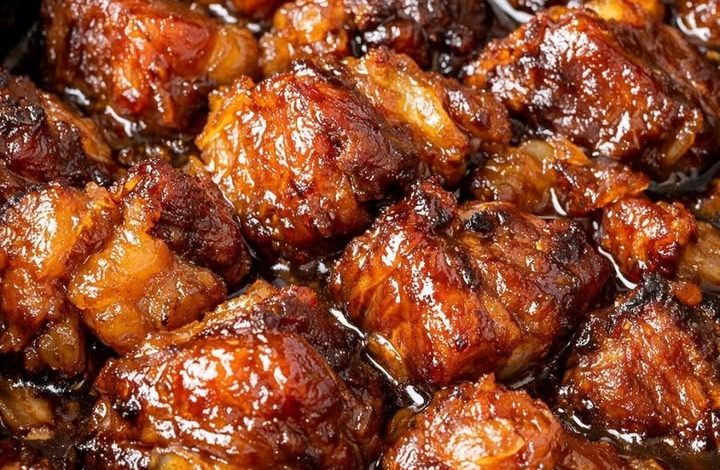
This 4-Ingredient Slow Cooker Sticky Ginger Country Ribs recipe is a masterclass in myofibrillar collagen gelatinization and low-temperature sucrose-lipid reduction. Country-style pork ribs contain dense networks of tough connective tissue (collagen) that require extended thermal exposure to denature into silky, fork-tender gelatin. By submerging the meat in an acidic, sugar-dense matrix of smoky-sweet barbecue sauce, ginger ale, and brown sugar, you create a high-osmotic environment. As the slow cooker simmers, the meat fibers relax and release their natural juices, while the ginger ale’s carbonation and acidity gently break down surface proteins. The final uncovered simmer drives off excess water, triggering a rapid Maillard reaction that transforms the remaining sugars and rendered pork lipids into a deep, glossy, pulling-tape glaze.
ADVERTISEMENT
4-Ingredient Slow Cooker Sticky Ginger Country Ribs
Ingredients:
| Ingredient | Quantity |
| Bone-in country-style pork ribs | 4 / lbs |
| Thick barbecue sauce (smoky-sweet) | 1 / cup |
| Ginger ale or ginger beer (regular, not diet) | 1/2 / cup |
| Brown sugar (packed) | 1/3 / cup |
Step-by-Step Directions:
Step 1: The Connective Tissue Prep: Pat the country-style pork ribs completely dry with paper towels. Use a sharp knife to trim away any excessively thick, loose exterior flaps of fat, while leaving a thin layer intact across the muscle fibers to preserve interior moisture during the long braise.
ADVERTISEMENT
Step 2: The Osmotic Ginger Glaze: In a medium mixing bowl, combine the thick barbecue sauce, ginger ale (or ginger beer), and packed brown sugar. Whisk vigorously until the sucrose crystals are completely dissolved into the liquid phase and the emulsion is smooth and pourable.
ADVERTISEMENT
Tip: Utilizing regular (non-diet) ginger ale is a vital structural requirement. The natural sucrose or high-fructose corn syrup in regular soda is absolutely necessary to achieve the sticky, caramelized reduction later on. Diet sodas rely on artificial sweeteners like sucralose or aspartame, which break down under prolonged heat and completely fail to thicken or caramelize, leaving you with a watery, bitter sauce.
Step 3: The Stratified Grid Alignment: Arrange the country ribs in a snug, even layer across the bottom of a large slow cooker basin.
Note: If the volume forces you to stack the meat, ensure you tuck the thickest, meatiest portions directly against the bottom floor of the crock so they sit completely submerged in the primary cooking reservoir.
Step 4: The Hydroolytic Slow Braise: Pour the ginger-barbecue glaze evenly over the ribs, using tongs to rotate the meat until every surface is fully coated. Lock the slow cooker lid in place. Program the unit to LOW for 7 / to 8 / hours (or HIGH for 4 / to 5 / hours) until the meat proteins are entirely tender and pulling away from the bone matrix.
Tip: Do not lift the lid to check the progress during the first few hours of cooking. A slow cooker relies on trapping a highly pressurized steam vault to maintain its internal temperature; opening the lid releases this moisture envelope and drops the heat, adding roughly 15 / to 20 / minutes to your total required cooking window for each peek.
Step 5: The Capillary Lipid Skim: Once the ribs reach a gelatinous, tender state, use a wide ladle or spoon to carefully skim the pools of clear, rendered yellow pork fat floating across the surface of the cooking liquid and discard them.
Note: Removing this un-emulsified surface fat is an efficiency-driven step; it prevents the final glaze from tasting greasy and ensures the dark, sugary barbecue molecules can physically stick to the meat fibers instead of sliding off.
Step 6: The Uncovered Sugar Pyrolyzation: With the ribs remaining in the crock, switch the slow cooker setting to HIGH (if cooking on low) and remove the lid completely. Let the liquid simmer uncovered for 20 / to 30 / minutes, spooning the bubbling sauce over the exposed ribs every few minutes.
Tip: This uncovered reduction window is the essential moisture-evaporation milestone. Leaving the lid off allows the water molecules from the meat juices and ginger ale to escape as vapor. This concentrates the remaining sugars, starch binders, and gelatin into a luxurious, shiny glaze that hardens slightly upon contact with the cooler air. Serve warm straight from the pot.