Why Do Maple Syrup Bottles Have Tiny Handles?
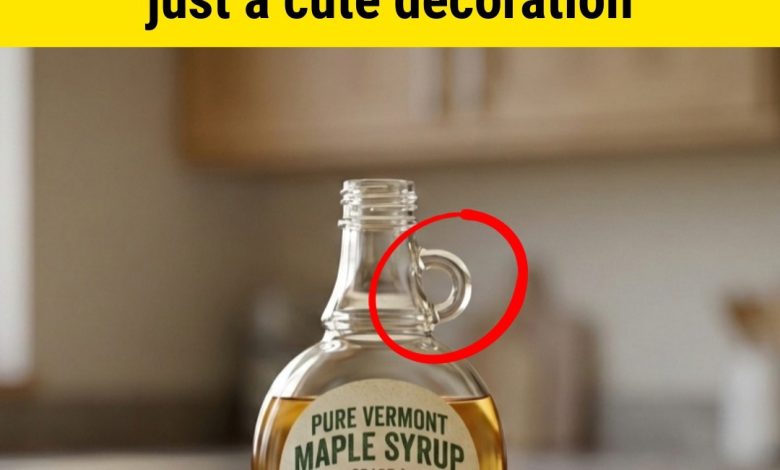
If you look closely at a classic bottle of maple syrup, you will notice a very specific detail. There is always a tiny, finger-sized loop located right on the neck of the container. You have probably never actually used it to carry the bottle. Let’s be honest, it is simply too small to grip comfortably with your hand. So, why do companies continue to manufacture bottles with this tiny feature?
ADVERTISEMENT
As one curious kid put it: “Why does the bottle have that little handle if it doesn’t even do anything?”
ADVERTISEMENT
The answer might surprise you. It is not an accident, and it is not a mistake made by modern factory machines. Instead, it is a deliberate nod to history. This little loop is a perfect example of what designers call a skeuomorph. A skeuomorph is a decorative feature on a modern product that mimics a functional element from the past, even when it no longer serves a practical purpose.
ADVERTISEMENT
From Heavy Ceramic Jugs to Sleek Glass Bottles
To understand why this little loop exists, we have to travel back in time. In the 1800s and the early part of the 1900s, maple syrup was handled much differently than it is today. It was not sold in dainty glass bottles or lightweight plastic containers. Instead, farmers and shopkeepers stored and transported syrup in large, heavy ceramic jugs.
These old-fashioned jugs frequently held a gallon or more of heavy liquid. Because ceramic is naturally heavy on its own, adding a gallon of syrup made the container incredibly difficult to manage. Therefore, these jugs had big, sturdy loop handles. People needed those large loops so they could safely lift, carry, and pour the syrup without straining their wrists. It also prevented them from accidentally dropping the container and spilling a very valuable harvest.
As the 20th century progressed, manufacturing methods improved significantly. Syrup producers began to switch away from heavy clay jugs. They started using glass bottles, which were much lighter, cheaper to make, and offered a clear view of the beautiful amber liquid inside. Later on, plastic became popular for the exact same reasons.
However, syrup makers did not want to abandon their history completely. They decided to keep a symbolic piece of the old ceramic jug design. They kept the handle, but they shrank it down significantly so it would fit on the slender neck of a modern bottle. Over time, the handle changed from a highly useful tool into a purely ornamental feature.
What’s a Skeuomorph? (And Why We Love Them)
The word “skeuomorph” might sound complicated, but the concept is actually very simple. It refers to any design element that imitates the form of an older object, even when the original function is completely gone. We see these kinds of designs all around us in our daily lives without even realizing it.
Here are a few common examples of skeuomorphs that you might recognize:
-
The decorative stitching printed onto leather-look vinyl car seats.
-
The fake wood paneling used on the sides of station wagons in the 1970s.
-
The digital “click” sound your smartphone camera makes when you take a picture, even though digital cameras do not have mechanical shutters.
The tiny syrup handle fits right into this category. It does not actually help you carry the bottle from the pantry to the kitchen table. However, it successfully evokes feelings of heritage, authenticity, and old-school craftsmanship. It gives consumers a sense of nostalgia. It whispers: “This isn’t just syrup—it’s tradition in a bottle.”
Why Not Make It Functional?
When thinking about this design, a very logical question might come to mind: “Why not make the handle big enough to actually use?”
There are two main reasons why major food brands prefer to keep the handle small:
First, it comes down to ergonomics. If a manufacturer placed a large, full-sized handle at the very top of a modern syrup bottle, it would make the entire container top-heavy. This would make it awkward and unstable when you try to pour it over your food.
Second, it is a matter of brand identity. That delicate little loop has become an essential part of the classic maple syrup look. It is an iconic image, much like the red-and-white checkered tablecloth at a traditional diner. If a company suddenly removed the loop or changed its shape, the bottle would look wrong to consumers, and they might not recognize their favorite brand on the grocery store shelf.
Fun fact: Some artisanal syrup makers do use larger handles on specialty bottles—but mass-market brands keep the tiny loop for instant recognition.
The Bigger Lesson: Design Isn’t Just Function
This tiny kitchen mystery teaches us a larger lesson about the products we buy. Good design is not always just about how well a product functions. It is also about balancing utility with human emotion. Sometimes, a completely useless visual detail carries a lot of meaning, memory, and emotional warmth.
So, the next time you pour sweet syrup over a fresh stack of pancakes, take a quick second to appreciate that tiny loop on the neck of the bottle. Try not to view it as a failed handle. Instead, look at it as a quiet tribute to the generations of hardworking farmers who carried heavy syrup jugs across snowy fields a long time ago.
It may not hold your fingers—but it holds history.
Did you know this? Share this fun fact at your next brunch—we bet your friends will look at their syrup bottle differently.