Can you figure it out in one try with no second guesses?
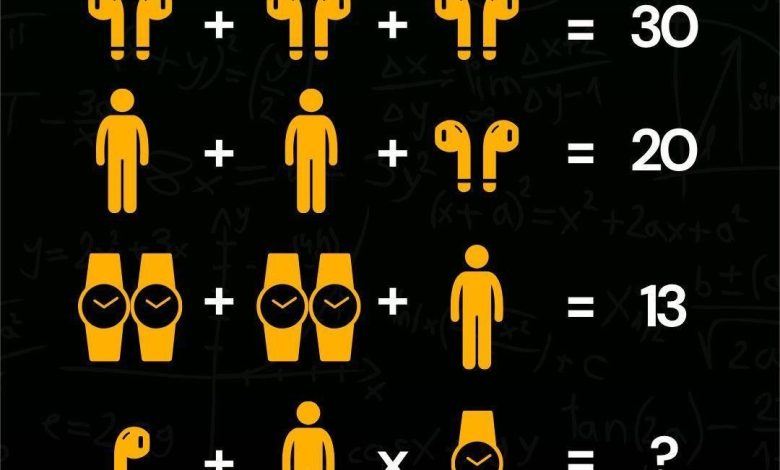
Take a moment. Look at the image. You get exactly one shot—no second guesses, no edits, no going back. At first glance, it appears to be a lighthearted brain teaser: a few icons, a couple of simple equations, and a final question mark waiting for your answer. But don’t let the simplicity fool you. This puzzle isn’t testing advanced math. It’s testing your attention to detail, your ability to stay consistent, and your willingness to look closely before you leap.
ADVERTISEMENT
Let’s walk through the steps of this challenge very carefully to see how the logic unfolds.
ADVERTISEMENT
Breaking Down the Logic
Step 1: The First Equation In the first line, we see three identical pairs of earbuds that add up to a total of 30. To find the value of just one set, we perform a quick division. Since there are three sets, each pair of earbuds equals 10.
ADVERTISEMENT
Step 2: The Second Equation The next line shows two people and one pair of earbuds totaling 20. We already established that the earbuds are worth 10. When we subtract that from the total, we are left with 10 for the two people. This means each person equals 5.
Step 3: The Third Equation Now things get more interesting. We have two pairs of watches plus one person, and the total is 13. Since we know the person represents 5, we subtract that from 13, which leaves us with 8 for the two sets of watches. Therefore, each pair of watches is worth 4. This also means that one single watch would be worth 2.
Step 4: The Final Line (Where Most People Slip) Now you are looking at the final expression: “Single earbud + Person × Single watch”. But if you look much closer, the visual details have shifted significantly. The objects are not the same as they were in the previous lines:
-
The earbud is no longer a pair. It is now a single unit, which represents half of the original value (5).
-
The person remains unchanged in this specific example (5).
-
The watch is no longer a pair. It is a single unit, representing half of that value (2).
When you plug those specific values into the final row, you get: 5 + 5 × 2.
Solving the Calculation
To find the correct result, you must remember the standard order of operations used in math. This rule states that multiplication must always be completed before addition.
-
First, calculate the multiplication: 5 × 2 = 10.
-
Next, finish with the addition: 5 + 10 = 15.
Final Answer: 15
Why This Puzzle Tricks So Many People
This is not actually a test of how hard the math is. Instead, it is a test of your visual discipline and how well you can spot tiny changes. The most common mistakes usually happen for three reasons:
-
People treat a single item as if it still has the same value as the pair.
-
Observers overlook the very subtle changes between each different equation.
-
Many forget the basic rule that multiplication must be solved before addition.
What Your Answer Reveals
If you arrived at 15, you showed a strong habit of verifying details rather than just assuming a pattern would stay the same. You truly read the problem instead of just scanning it quickly. If you landed on a different number, you likely let the feeling of familiarity rush you past the fine print. You may have trusted the rhythm of the first few lines instead of checking to see if the rules changed at the very end.
The deeper takeaway here is that puzzles like this are not just about measuring raw intelligence. They are measuring cognitive discipline. The biggest trap we face is not complexity; it is the quiet assumption that something looks simple enough to solve on autopilot.
Solving this challenge was not just about finding the right number. It was about proving whether you observe carefully, think in a structured way, or let your brain take a shortcut through the work. In a world that often rewards speed over precision, that distinction is very important.
Because the real question was never “What’s the answer?” It was “Did you actually look?”