Why Women’s Shirts Button on the Left — and Men’s on the Right: The Fascinating History Behind a Daily Habit
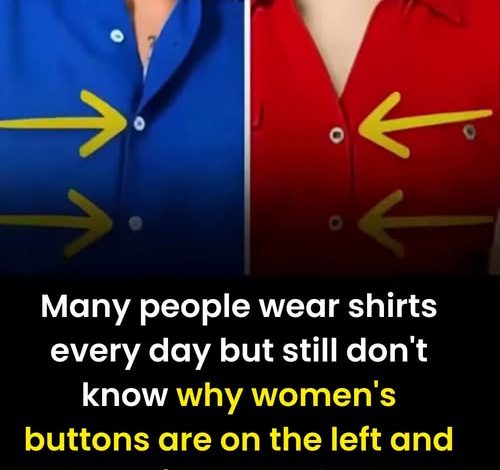
Every morning, millions of people around the world perform a simple, automatic ritual: they button up their shirts. It is such a routine part of life that we rarely stop to look at the garment in our hands. However, if you look closely, you will see a strange inconsistency. Men’s shirts consistently have buttons on the right side, while women’s shirts have them on the left.
ADVERTISEMENT
This isn’t just a random design choice. It is a tradition that has lasted for centuries. The reasons behind this tiny detail offer a window into the past, touching on everything from social status to ancient combat.
ADVERTISEMENT
1. The Historical Roots in the 1800s
To understand why we dress the way we do today, we have to look back to a time when clothing was far more complex than a simple t-shirt and jeans. In the 18th and 19th centuries, fashion was a clear indicator of a person’s place in society.
ADVERTISEMENT
The Reason for Women: Buttons on the Left
During the Victorian era, wealthy women wore elaborate outfits involving corsets, petticoats, and many layers of fabric. Because these garments were so difficult to put on, “Wealthy women were dressed by servants.” Since the majority of people are right-handed, a maid or servant standing in front of a lady would find it much easier to close buttons that were placed on the left. This allowed the staff to work quickly and efficiently. Over time, as mass-produced clothing became available to everyone, the “left-side” placement stuck. Even though most women began dressing themselves, the design remained a symbol of high-class origins and eventually became a fixed standard in the fashion industry.
2. The Logic Behind Men’s Clothing
Men’s clothing followed a completely different path, largely because their daily lives and social expectations were different. Unlike the women of the upper class, most men—even those with money—tended to dress themselves.
The Reason for Men: Buttons on the Right
There is a very practical, and somewhat dangerous, reason for this. In historical times, “Men often carried weapons.” Specifically, men frequently wore swords on their left hip so they could be drawn quickly with the right hand.
If a shirt or jacket buttoned from right to left, the hilt of the sword could easily catch on the fabric flap as it was being pulled out. By having the shirt flap open from left to right (with buttons on the right), a man could draw his weapon smoothly without any interference. Furthermore, because most men were right-handed and dressed themselves, having the buttons on the right side simply made the most sense for their own coordination.
3. Why the Tradition Still Exists Today
You might wonder why, in a world where we no longer carry swords or employ teams of servants to help us dress, we still follow these rules. The answer is simple: tradition is hard to break.
Once a manufacturing standard is set, it is very expensive and confusing to change it. Throughout the Industrial Revolution, garment factories followed these established patterns to keep production consistent. Designers today continue to follow these rules because it is what consumers expect to see. It has become a “silent code” of the fashion world that persists even though the original reasons have long since faded away.
4. Does the Placement Matter in Modern Life?
In practical terms, it doesn’t matter at all. Most people are so used to their specific button orientation that they don’t even have to look while they do it. However, it remains a “fun detail that reveals just how much history hides in everyday objects.”
While some modern or unisex brands are starting to ignore these old rules to create more neutral clothing, the vast majority of retailers still stick to the classic layout. It serves as a subtle reminder that our modern lives are still built on the foundations of the past.
Final Thought
The next time you are getting ready for work or a night out, take a moment to look at your sleeves or your collar. “You’re taking part in a tradition hundreds of years old — one rooted in servants, swords, and society.” It is proof that even a small piece of plastic or pearl can tell a story that spans generations.