“If you won’t do what my son wants, pack your bags and go,” my mother-in-law said after my husband brought up divorce yet again. I was 49, and after 24 years of marriage, I knew exactly what they expected me to do. Swallow whatever I wanted to say, give him his way, and keep the peace. My mother-in-law was so sure I’d do it again. This time, I surprised her…
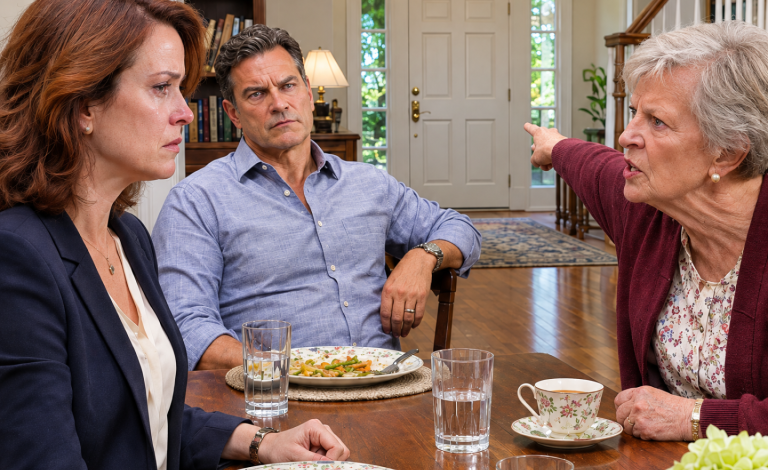
This story centers on years of control, emotional pressure, and a wife finally realizing she has more power than her husband ever wanted her to know. The rewrite below keeps the drama and tension while improving flow, pacing, and readability.
ADVERTISEMENT
Part 1: My Husband Said He’d Divorce Me If I Didn’t Quit My Job. He Forgot One Important Detail About Our House.
“If you don’t quit your job by the end of the month, I’m filing for divorce. And you’ll need to find somewhere else to live.”
ADVERTISEMENT
My husband, Marcus, delivered the threat as calmly as if he were discussing a utility bill.
ADVERTISEMENT
Across the table, my mother-in-law, Teresa, nodded in approval.
“Your husband has made himself very clear, Natalie,” she said. “If you can’t support his decision, perhaps it’s time for you to leave.”
At forty-nine years old, I should have been shocked. Instead, I felt tired.
Marcus and I had been married for twenty-four years, and divorce threats had become one of his favorite weapons whenever he didn’t get his way.
But this time was different.
This time, he was asking me to give up something I had spent years building.
For fifteen years, I had worked my way up the corporate ladder at a regional food logistics company outside Chicago. As Senior Operations Director, I managed eighteen employees, oversaw major accounts, and earned a salary that covered a significant share of our household expenses.
Marcus wanted me to resign and devote myself full-time to caring for Teresa.
“I’m not quitting my job,” I said carefully. “We can hire a home health aide and divide the rest of the responsibilities ourselves.”
Teresa set her teacup down with a sharp click.
“One of the women at church has a daughter-in-law who stays home and takes care of everything,” she said. “That’s what a real family does.”
“That works for them,” I replied. “It doesn’t have to work for us.”
Marcus pointed toward the front door.
“Fine. Then go rent an apartment and see how long you last without me.”
My eyes drifted toward the hallway.
The wall still held pencil marks showing our children’s heights through the years. Daniel had learned to ride his bike in the driveway. Chloe had spent endless summer afternoons in the backyard with friends.
For years, Marcus had referred to the property as his house.
And for years, I had let him.
What he conveniently ignored was that the house had belonged to my grandparents long before I married him. My parents had transferred ownership to me before our wedding, and the deed had always been in my name alone.
Marcus knew that.
He had known it from the very beginning.
Four years earlier, after his father passed away, Teresa moved into our guest suite on the main floor. At first, helping her felt natural. I installed safety bars in the bathroom, organized her medications, cooked meals, and drove her to appointments.
But over time, gratitude turned into expectation.
If dinner wasn’t ready, she complained.
If I asked Marcus to handle one of her appointments, he accused me of neglecting his mother.
And whenever I pushed back, he threatened divorce.
In the beginning, I argued.
Eventually, I apologized just to keep the peace.
That night, I went upstairs without making any promises.
Inside our bedroom, I opened a folder containing our property records.
There it was.
The deed.
Dated before our marriage.
My name listed as the sole owner.
As I stared at the paperwork, I remembered something my father had said the day he handed me the documents.
“A woman should never have to wonder whether she’ll lose her home because someone else is in a bad mood.”
The next morning, Marcus asked if I had changed my mind.
“I’m thinking about it,” I said.
He smiled, convinced time would wear me down.
Instead, I drove to work and scheduled a consultation with Amanda Ross, a family-law attorney in downtown Chicago.
Over the next week, I quietly gathered documents: title records, tax returns, bank statements, renovation receipts, and financial records.
When Amanda reviewed everything, she nodded.
“The house was transferred to you before the marriage,” she explained. “Based on the records you’ve provided, it appears to be non-marital property. We’ll still need to evaluate any marital contributions used for renovations and improvements, but your husband cannot simply claim ownership because he says so.”
A weight I’d been carrying for years began to lift.
Amanda also advised me not to make any impulsive decisions.
“No changing locks,” she said. “No forcing anyone out. Follow the legal process.”
I wasn’t interested in revenge.
I simply needed to know whether Marcus’s favorite threat had any real power behind it.
Now I had my answer.
For the first time in decades, I could think about my future without fear.
And for the first time in my marriage, I realized I had more choices than Marcus wanted me to believe.
Part 2: My Husband Threatened to Throw Me Out. Then Our Children Finally Said What They’d Been Watching for Years.
After meeting with Amanda, I returned home carrying knowledge Marcus didn’t know I had.
For twenty-four years, he had spoken as though our home belonged solely to him. Now I knew the truth.
The house my parents had given me before our wedding was legally mine.
I wasn’t ready to confront him yet.
First, I wanted a clear picture of our finances.
At work, I created a detailed spreadsheet and began reviewing everything: taxes, insurance, groceries, utilities, tuition payments, medical expenses, and renovation costs.
The numbers told a very different story from the one Marcus always repeated.
My income covered most of the property taxes, insurance premiums, maintenance expenses, and grocery bills. I also paid a substantial portion of Chloe’s college costs and helped cover Teresa’s medical needs.
Marcus contributed, particularly toward certain home improvements.
But his constant claims that he carried the entire household simply weren’t true.
In reality, he maintained an expensive country-club membership, leased a high-end pickup truck, and regularly transferred money into his personal investment accounts.
The deeper I looked, the clearer one fact became.
I was not financially dependent on Marcus.
If anything, he depended more on me than he cared to admit.
A week later, the subject came up again during dinner.
Daniel had stopped by from his apartment, and Chloe was home from Northwestern for the weekend.
“Have you talked to Human Resources yet?” Marcus asked.
“No.”
He frowned.
“Why not?”
“Because I’m not quitting.”
Teresa immediately set down her fork.
“You’re really willing to throw away your marriage for a job?”
“I’ve already offered a solution,” I said. “We can hire professional help. Nobody has to give up their life.”
Marcus turned sharply toward the kids.
“This is a conversation between your mother and me.”
Chloe didn’t back down.
“Dad, are you seriously threatening divorce because Mom wants to keep her job?”
“Stay out of it.”
“I’m twenty-one,” she replied. “I am involved. And I’ve been listening to you threaten Mom for years.”
Silence fell across the table.
Marcus’s jaw tightened.
“You don’t understand marriage.”
Until then, Daniel had stayed quiet.
When he finally spoke, his voice was calm.
“We understand a lot more than you think, Dad. Everybody in this house watches your mood before they say anything.”
The words hit me harder than I expected.
For years, I had convinced myself that giving in protected my children from conflict.
Instead, they had seen everything.
Every threat.
Every apology.
Every time I made myself smaller to keep the peace.
Marcus shoved his chair back and walked out before finishing dinner.
After he left, Chloe reached across the table and squeezed my hand.
“Mom,” she said softly, “you don’t have to live like this anymore.”
I wanted to give her an answer.
But the truth was, I still didn’t know what came next.
Two weeks later, my seventy-three-year-old mother, Evelyn, arrived from Ohio before an early cardiology appointment at Northwestern Memorial Hospital.
I prepared the upstairs guest room so she wouldn’t have to make the long drive before dawn.
When Marcus came home and saw her overnight bag, his expression darkened instantly.
“What’s this?”
“Mom has a hospital appointment tomorrow,” I explained. “She’s staying one night.”
He looked directly at Evelyn.
“Are we operating a hotel now?”
My mother immediately reached for her purse.
“I can get a room somewhere,” she said quietly. “I don’t want to cause problems.”
“You’re staying right here, Mom,” I said.
From her armchair, Teresa shook her head.
“A respectful wife asks permission before inviting guests.”
I stared at her in disbelief.
“You’ve lived here rent-free for four years,” I said. “My mother needs one night.”
“That was different,” Marcus snapped.
“Why?”
“Because it was my decision.”
I felt something shift inside me.
“And this one is mine.”
Marcus slammed his fist against the kitchen island.
The coffee mugs rattled.
“This is my house!” he shouted. “If you don’t like my rules, pack your things and leave tonight. We’re getting divorced.”
My mother flinched.
Chloe covered her mouth.
Teresa sat quietly, waiting for the apology she clearly expected.
The one I had given countless times before.
My heart pounded.
But this time, I wasn’t afraid.
I remembered the deed.
I remembered Amanda’s advice.
And I remembered my children reminding me that they had seen everything.
For years, Marcus had relied on the same threat because it always worked.
Only now, it didn’t.
“Okay,” I said calmly.
Marcus froze.
His eyes narrowed.
“What did you just say?”
This section is the story’s turning point. The rewrite below increases the emotional impact, sharpens the dialogue, and builds stronger momentum toward the divorce while keeping the same core events.
“Then I accept.”
Marcus frowned.
“What?”
“I accept your offer. Let’s get divorced.”
For the first time that evening, his confidence slipped.
The certainty that had filled his voice moments earlier seemed to drain away.
“You’ll come crawling back once you realize what you’re losing.”
I glanced toward my mother, who was still clutching her purse as though she expected to be thrown out at any moment.
“No, Marcus,” I said calmly. “I finally know exactly what I’ve been losing all these years.”
Without another word, he turned and headed upstairs.
He wasn’t worried.
Not really.
Like every other time he had threatened divorce, he assumed I would apologize, surrender, and ask him for forgiveness by morning.
What he didn’t understand was that something had changed.
I wasn’t afraid anymore.
The next afternoon, I returned from my attorney’s office carrying a thick black binder.
Inside were financial records, legal documents, a draft divorce petition, and one certified document that changed everything.
Marcus was sitting in the den when I walked in.
The moment he noticed the binder, a smug smile crossed his face.
“What’s that?” he asked. “Your resignation paperwork?”
I set the binder carefully on the coffee table between us.
“No.”
His smile lingered.
“Then what is it?”
“Our divorce petition.”
The smile disappeared.
Marcus sat up straighter and opened the binder.
At first, his expression remained skeptical.
Then he turned another page.
And another.
Finally, he stopped.
His eyes locked onto a certified copy of the property deed.
The color slowly drained from his face.
Part 3: My Husband Ordered Me Out of His House. Then the Property Deed Revealed Who Really Owned It
For several long seconds, Marcus stared at the document without speaking.
Then he looked up at me as if I had handed him evidence from a completely different life.
“What exactly is this supposed to prove?”
“That the house was given to me before our marriage,” I replied evenly. “My name has been on the deed for twenty-four years.”
Across the room, Teresa adjusted her glasses and leaned forward.
“That can’t be right,” she said. “My son has lived here for decades. He’s paid for this house.”
“He contributed to the household,” I said. “Just like I did. But contributing doesn’t change who legally owned the property before the marriage.”
Marcus flipped through the binder, suddenly moving much faster.
Behind the deed were property tax records, title documents, renovation receipts, financial statements, and years of supporting paperwork.
“You can’t act like I never paid for anything,” he snapped. “I paid for the deck. I helped remodel the kitchen.”
“I never said otherwise.”
I opened the binder to a detailed accounting Amanda had prepared.
Every major improvement was listed.
Every payment was documented.
Every expense was traced.
“Some renovations were paid for by you. Some were paid for by me. Others came from joint funds,” I explained. “My attorney has already reviewed everything. Any documented marital contributions can be addressed fairly.”
Marcus shoved the binder away.
“So that’s it? You’re throwing me and my mother out onto the street?”
“No.”
I slid another document toward him.
“You have sixty days.”
He looked down at it.
“My attorney prepared a proposed transition agreement. Nobody is being locked out. Nobody is being thrown out overnight. You’ll have time to make arrangements.”
Teresa shook her head in disbelief.
“After everything Marcus has done for you, this is how you repay him?”
I turned toward her.
“For four years I’ve managed your medications, scheduled appointments, prepared meals, and taken care of your daily needs.”
Her expression tightened.
“I never asked you to leave,” I continued. “But yesterday you sat there while your son tried to throw my seventy-three-year-old mother out of the house because she needed a place to sleep before a hospital appointment.”
For the first time since the argument began, Teresa didn’t have an answer.
She looked away.
Marcus folded his arms.
“You planned this behind my back.”
“I got legal advice after you threatened to divorce me and make me homeless.”
“Listen to yourself,” he scoffed. “You sound like one of those people from your office.”
I almost laughed.
After all these years, that was his response.
“No, Marcus,” I said quietly. “I sound like someone who’s finally making her own decisions.”
At that moment, Daniel and Chloe stepped into the room.
Neither of them looked surprised.
Marcus immediately turned toward them.
“Tell your mother she’s being unreasonable.”
Neither child spoke.
He pressed harder.
“She wants to throw her husband out after twenty-four years.”
Daniel exhaled slowly.
“Dad, you’ve threatened to throw Mom out for years.”
Marcus stiffened.
“You don’t know what you’re talking about.”
“Yes, I do,” Daniel replied. “Because we’ve all heard it.”
The room fell silent.
“You can’t spend years telling someone they’ll lose their home and then act shocked when they finally believe you.”
Marcus opened his mouth.
Daniel continued.
“I love you, Dad. But you’re not the victim here.”
The words landed harder than any argument.
Chloe stepped beside me.
“I support Mom,” she said firmly. “Everyone deserves to live in a home where they’re not threatened every time they disagree with someone.”
Teresa attempted a softer approach.
“Families argue,” she said. “People say things they don’t mean.”
I nodded.
“They do.”
Then I met her eyes.
“But this wasn’t one argument.”
I reminded her of the canceled trips to visit my mother.
The fights about money.
The criticism whenever work required longer hours.
The countless times Marcus responded to disagreement with the same threat.
Do what I want or I’ll divorce you.
Do what I want or leave.
Do what I want or lose your home.
For years, I had mistaken those demands for marital conflict.
Now I recognized them for what they were.
Control.
Marcus picked up the financial summary one last time.
“So you’re ending twenty-four years of marriage because I asked you to take care of my mother?”
I shook my head.
“No.”
My voice was calm.
“I’m ending it because you demanded that I give up my career, my independence, and my future. And when I refused, you tried to use fear to control me.”
For the first time, he had no immediate response.
No threat.
No ultimatum.
No warning.
Only silence.
Finally, he closed the binder.
The sound echoed through the room.
“I’m getting my own attorney.”
“You should,” I replied. “I want this handled fairly and legally.”
That night, Marcus slept alone in our bedroom.
I stayed in the guest room with my mother nearby.
Hours later, as I folded a blanket at the foot of the bed, she touched my shoulder.
“Your father would be proud of you.”
The words broke something open inside me.
Tears filled my eyes before I could stop them.
“I should have stood up for myself years ago.”
She pulled me into a hug.
“Maybe,” she whispered. “But you stood up for yourself now. That’s what matters.”
The weeks that followed were exhausting.
Attorneys reviewed decades of financial records, retirement accounts, renovation expenses, and property documents.
Marcus continued insisting that twenty-four years of living in the house should make it his.
But after reviewing the title history, even his own attorney confirmed what Amanda had already explained:
The home was my non-marital property.
Any marital contributions could be addressed financially.
Ownership was a different matter.
After that, Marcus stopped pointing toward the front door during arguments.
For the first time in years, he no longer spoke as though he had the authority to decide whether I deserved a place in my own home.
As negotiations moved forward, a settlement slowly took shape.
Marcus would keep his leased luxury pickup and a larger share of his executive pension. Our joint savings would be divided fairly, and reimbursement for documented improvements to the property would be factored into the agreement.
It wasn’t revenge.
It wasn’t punishment.
It was simply the legal unwinding of a marriage.
And as the settlement neared completion, I realized the most difficult part wasn’t protecting my home.
It was finally accepting that the marriage I had spent twenty-four years trying to save had ended long before either of us signed the paperwork.
This closing section works best when it feels emotional, reflective, and earned. The rewrite below strengthens Marcus’s final realization, Natalie’s growth, and the story’s central theme: reclaiming choice after years of control.
Marcus lingered in the foyer.
For a moment, neither of us spoke.
He stood beside the same front door he had pointed toward countless times whenever he wanted to remind me that he could make me leave.
Only now, that power was gone.
The silence stretched between us before he finally cleared his throat.
“Are you really not going to ask me to stay?”
His voice was softer than I expected.
Not angry.
Not commanding.
Just uncertain.
I looked at the man I had married at twenty-five.
I remembered the good years.
The young father proudly holding our newborn son.
The husband who used to bring me coffee on lazy Sunday mornings.
The man who ran beside our daughter’s bicycle until she learned to ride on her own.
Those memories mattered.
They were real.
But so were the years that came afterward.
The threats.
The ultimatums.
The constant pressure to surrender pieces of myself in exchange for peace.
“I asked you to stay for years, Marcus.”
His forehead creased.
“When?”
“Every time you threatened divorce and I gave up something important to keep our marriage together.”
He stared at me.
I continued quietly.
“Every trip I canceled. Every apology I made when I wasn’t at fault. Every opinion I swallowed. Every decision I accepted because I was trying to save us from another fight.”
His jaw tightened.
“You never said it that way.”
“I shouldn’t have had to.”
For a few moments, neither of us spoke.
“I never thought you’d actually go through with it,” he admitted.
And for the first time, I understood exactly what he meant.
He had never believed I would leave.
Never believed I would stop apologizing.
Never believed I would choose myself.
For twenty-four years, fear had always done the work for him.
Until it didn’t.
Marcus lowered his eyes.
Then he picked up his last bag.
Without another word, he walked out the front door.
Daniel was waiting beside the moving truck.
I watched them drive away.
Then I gently closed the door behind them.
The lock clicked.
Soft.
Simple.
Final.
For the first time in twenty-four years, that doorway no longer represented a threat hanging over my head.
It was simply the entrance to my home.
A few minutes later, Chloe found me standing in the foyer.
“Mom?”
I turned.
“Yeah?”
“Are you okay?”
The question lingered for a moment.
I thought about everything that had happened.
The grief.
The relief.
The uncertainty.
The freedom.
“Not completely,” I admitted.
Chloe wrapped her arms around me.
And for the first time in a very long while, I allowed myself to lean on someone else.
“But I think I’m going to be.”
That evening, the house felt different.
Quieter.
Not empty.
Just peaceful.
There was no television playing downstairs.
No keys tossed onto the counter.
No tension in the air while I wondered whether a simple decision would start another argument.
I walked through the hallway lined with marks showing the children’s heights over the years.
Then I stepped into the kitchen we had renovated together.
The memories remained.
Some happy.
Some painful.
All of them part of my story.
I still grieved the marriage.
You don’t spend twenty-four years building a life with someone and simply stop caring.
But alongside the grief was something I hadn’t felt in years.
Freedom.
I no longer needed permission to make choices.
I no longer rehearsed explanations before speaking.
I no longer worried that disagreement would cost me my home.
As I switched off the kitchen lights, a realization settled over me.
Keeping the house wasn’t the greatest thing I had regained.
What I had truly recovered was myself.
Part 5: My Husband Used Divorce as a Weapon for Twenty-Four Years. Six Months Later, He Asked for Another Chance.
The first few weeks after Marcus moved out felt stranger than I expected.
Every evening around five-thirty, I caught myself checking the clock at work.
For years, coming home late had meant preparing for questions.
Why was I late?
Who kept me?
Why was my job more important than my family?
Even after the divorce, those habits lingered.
Nobody was waiting to interrogate me anymore.
Yet sometimes I still felt the old anxiety.
Healing, I learned, wasn’t automatic.
It happened one day at a time.
There were mornings when I expected to hear Marcus shaving in the bathroom or Teresa’s television humming downstairs.
I missed certain routines.
I missed familiar sounds.
I even missed parts of the life we’d built together.
What I didn’t miss was the fear.
Twenty-four years of marriage doesn’t disappear the moment a judge signs paperwork.
But it changes.
And eventually, so do you.
I remained in the colonial home in Glenview.
One of the first things I did was redesign the upstairs guest room.
Fresh paint.
New bedding.
A comfortable reading chair beside the window.
My mother now had a permanent place to stay whenever she visited from Ohio.
No permission required.
No explanations needed.
Daniel continued seeing his father regularly.
They still watched football together on Sundays.
Chloe occasionally met Marcus for lunch between classes.
I encouraged both relationships.
Divorce ends a marriage.
It doesn’t erase family.
But I noticed something different about my children.
Something healthier.
When Marcus pressured Daniel to abandon environmental engineering for a career in investment banking, Daniel politely listened.
Then he smiled and kept studying environmental engineering.
When Chloe announced plans to spend a semester abroad in Spain, Marcus objected immediately.
She thanked him for his opinion.
Then she bought the ticket anyway.
Neither child stopped loving their father.
They simply stopped confusing his approval with authority.
And that made all the difference.
Several months later, Teresa called.
“Natalie, my arthritis has been getting worse. I have an orthopedic appointment next week. Can you take me?”
For years, I would have automatically rearranged my schedule.
This time, I paused.
“For a routine appointment, you’ll need to ask Marcus or Daniel,” I said. “If you have an emergency, I’ll help however I can.”
Silence.
Then surprise.
“But you always handled my appointments.”
“We don’t live together anymore, Teresa.”
The line was quiet for several seconds.
Then she thanked me and hung up.
Daniel ultimately drove her.
Everything worked out.
The difference was simple.
I was no longer responsible for carrying everyone else’s obligations.
Six months after the divorce was finalized, Marcus called.
“Natalie,” he said, “I’ve been thinking about us.”
I waited.
“Maybe we ended things too quickly.”
The statement was so unexpected that I almost laughed.
After years of divorce threats, now he thought we had moved too fast.
“I know I was difficult sometimes,” he continued. “Maybe we should try counseling.”
The words hurt more than I expected.
Not because I wanted him back.
Because I had begged for that kind of effort years earlier.
Back when there was still something to save.
“What do you mean when you say you were difficult?” I asked.
He hesitated.
“I had a temper. Sometimes I said things when I was frustrated.”
“Do you understand why I refused to quit my job?”
“Of course. Your career mattered to you.”
I closed my eyes briefly.
“That isn’t what I’m asking.”
A sigh escaped through the phone.
“I’m trying, Natalie.”
“No. I’m asking whether you understand that I had the right to make my own decisions.”
Silence.
“You had the right to work.”
“The right to work,” I repeated. “The right to invite my own mother to stay one night before a hospital appointment. The right to disagree with you. The right to have an equal voice in my marriage.”
A long pause followed.
Then he said quietly:
“You didn’t have to destroy our entire life over it.”
And there it was.
The answer.
Even now, he believed my refusal to obey had ruined the marriage.
Not the years of threats.
Not the control.
Not the ultimatums.
My refusal.
I felt a sadness deeper than anger.
Because at that moment, I understood he still didn’t see it.
“Marcus,” I said, “I have one question.”
“Okay.”
“If the house had been in your name that night, would you really have let me stay after you ordered me out?”
The silence that followed lasted several seconds.
Then several more.
He never answered.
He didn’t have to.
I already knew.
“Goodbye, Marcus.”
And I ended the call.
Today, I still live in the same colonial home my parents gave me before my wedding.
The front door is painted bright red now.
My mother’s guest room is always ready.
Daniel and Chloe visit often.
Most importantly, nobody enters this house worried about someone else’s mood.
I still work as Senior Operations Director.
I still lead my team.
I still enjoy a career I once considered sacrificing to save a marriage.
I don’t celebrate the divorce.
Marcus and I shared good years.
We raised two wonderful children together.
Those memories deserve respect.
But I also remember the other things.
The unnecessary apologies.
The canceled plans.
The fear.
The feeling that peace always depended on surrendering a little more of myself.
Years ago, when my father transferred that house into my name, he wasn’t trying to protect me from marriage.
He was trying to protect my ability to choose.
For a long time, I didn’t understand the difference.
Marcus believed divorce was his ultimate weapon.
He thought the possibility of losing my marriage and my home would always force me to comply.
What he never understood was that dignity and security are not opposites.
The night he ordered me to pack my bags, I finally realized I didn’t have to sacrifice one to keep the other.
I could have both.
And when I answered his ultimatum with a simple, calm “Okay,” I wasn’t destroying my family.
I was breaking a cycle that had taught everyone in our home to mistake fear for love.
For the first time in decades, we were all finally free.
THE END.