Found thousands of these translucent blue, plastic-looking ovals washed up on the beach today. They have a stiff fin on top and blue jelly underneath. Are they dangerous?
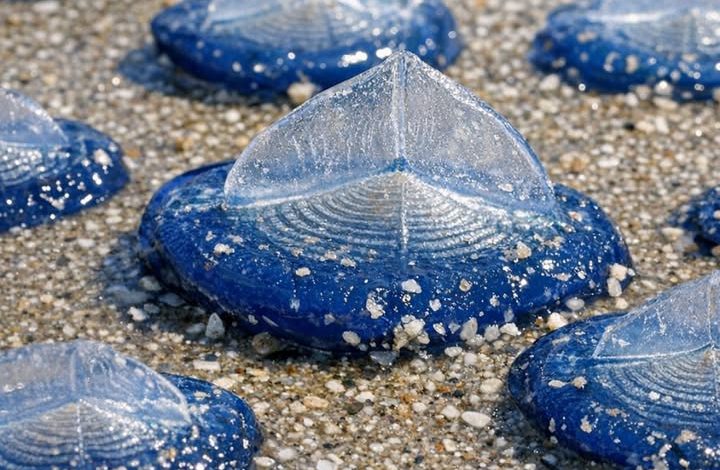
If you’ve recently walked along the shoreline and spotted thousands of tiny, blue, plastic-like shapes, you aren’t alone. These strange-looking objects are actually living creatures that often arrive on the coast in massive numbers. While it can be a bit shocking to see so many of them at once, they are a normal part of the ocean’s cycle.
ADVERTISEMENT
What are these blue ovals?
These creatures are known as “By-the-Wind Sailors,” or by their scientific name, Velella velella. Even though they look like a single animal, they are actually a colony of tiny organisms living together as one.
ADVERTISEMENT
Each one has a flat, blue base and a clear, stiff fin on top. This fin acts just like a sail on a boat. Since they live on the surface of the water, they rely entirely on the wind to move them across the sea. When the wind blows toward the land for a long time, thousands of these “sailors” end up washing onto the sand.
ADVERTISEMENT
Are they dangerous to touch?
For most people, these creatures are not dangerous. They do have tiny stinging cells that they use to catch even smaller ocean life for food, but these are usually too weak to hurt humans.
However, you should still be careful. If you have very sensitive skin, you might feel a little bit of a tingle or get a small rash if you touch them. It is always a good idea to avoid touching your eyes or mouth after handling anything on the beach. If a child or a pet accidentally eats one, it could cause an upset stomach, so it is best to keep a close watch on them.
How to tell them apart from “The Portuguese Man o’ War”
It is very common for people to confuse these harmless sailors with the more dangerous “Portuguese Man o’ War.” Here is how you can tell the difference:
-
Size: By-the-Wind Sailors are small, usually about 6/7 cm long. The Man o’ War is much larger and looks like an inflated balloon.
-
Tentacles: The sailors have very short, fuzzy-looking parts underneath. The Man o’ War has very long, thick tentacles that can reach many feet into the water.
-
The Sting: While the sailor is mostly harmless, the Man o’ War has a very painful sting that needs medical attention.
Why do they wash up in such huge numbers?
When you see a beach covered in blue, it is usually because of a “mass stranding.” This happens when strong winds push the colonies toward the shore. Because they cannot swim on their own, they have no way to turn back toward the deep ocean.
This usually happens during the spring or summer months. While it might look like a disaster, it is actually a natural event. Once they are on the beach, they become a source of food for birds and other beach-dwelling animals. They eventually dry out and lose their bright blue color, turning into thin, clear husks that look like pieces of plastic.
What should you do if you see them?
If you find them on the beach, the best thing to do is simply look and learn.
-
Don’t try to save them: Once they are on the sand, they are usually already dying or dead.
-
Leave them for nature: They are an important part of the food chain.
-
Keep pets away: To avoid any stomach issues, make sure dogs do not try to eat them.
Seeing thousands of these “By-the-Wind Sailors” is a great reminder of how vast and mysterious the ocean is. As long as you keep a respectful distance, they are a beautiful and safe sight to enjoy during your beach visit.